
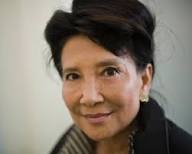
Members had previously enjoyed Jung Chang’s first book, Wild Swans (1991), the gripping account of the lives of three generations of women in her family, moving from the horrors of foot binding to their experiences of the Cultural Revolution. Fly Wild Swans, My Mother, Myself and China is a continuation of her story and a more reflective account of how she herself moved from indoctrination to intellectual freedom.
It opens with her family’s experiences at the hands the Revolutionary Guards. Even though her parents were committed communists and Party loyalists, they suffered with imprisonment and torture, and her father never recovered. We learn how children in school were brainwashed, sometimes turning against their own parents, and she herself was a fervent young revolutionary.
Later, however, she was able to go to university to study English and won a scholarship to come to England to read for a PhD in linguistics at York university. She tells of the close surveillance by the Chinese authorities and the rigid rules about what she was allowed to do. However, she learned to think independently and she began to reflect on her earlier commitment to Mao Zedong. Her fluency in English enabled her to participate fully in the academic life which led to her intellectual transformation.
She took advantage of a brief window of opportunity in the ‘70s and ‘80s when the rules were relaxed in China to visit her family with her second husband and to research a biography of Mao which they both were writing. It was interesting to read how extensively she travelled and what access she was given to important dignitaries and their wives. These were often gracious dignified women who nevertheless had played key roles in various atrocities but were willing to speak very frankly to her.
One of the strengths of the book is her warm relationship with her mother – a wise and clever woman who initiated and did a lot of the research for Chang’s biography of Mao. She refers to her book as a love-letter to her mother, who was only allowed to visit England once – she was very impressed with Harrod’s – but they communicated regularly until her mother’s death at the time of publication of Fly Wild Swans.
Because it is a personal memoir, some readers find it less gripping and more reflective than her first book, and it has been criticised for being over-political. However, it opens a window into a hitherto unknown world and culture, and we enjoyed her clear straightforward style of writing. It is not surprising that she is now unable to travel to China in safety.
Our next book is Mothering Sunday by Graham Swift.